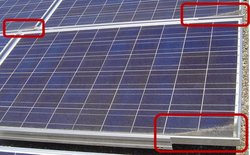
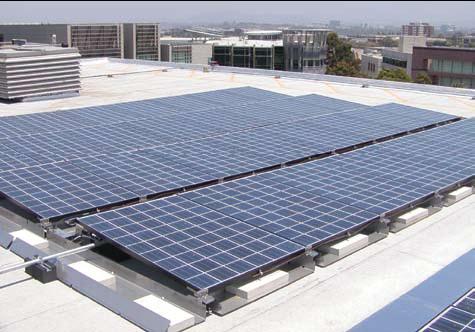
Part 1 Cleaning Your Solar Panels: One obvious yet often overlooked cause of a decline in the efficiency of your solar panel is the presence of dirt. Depending on your location, pollen, sand and other debris could be the culprit. When dirt accumulates on the solar panels it decreases the amount of solar radiation available for use, so in order to get the most out of your solar panels, frequent inspection and cleaning should be done. Tilted panels can be cleaned less often dueto rain runoff, a benefit flat panels do not have. Tools You’ll Need: Ladder, Warm Water, Soft Rags, Dish Washing Soap or Chemical Free Cleaners. Warm water can initially be used to remove the majority of the dirt. If there are still spots on the panel a combination of water and dish soap or natural cleaners can be used along with a soft rag to gently wipe away the remaining debris. Other options include auto cleaning systems which make it easier to keep panels clean in harder to reach areas. One obvious yet often overlooked cause of a decline in the efficiency of your solar panel is the presence of dirt. Depending on your location, pollen, sand and other debris could be the culprit. When dirt accumulates on the solar panels it decreases the amount of solar radiation available for use, so in order to get the most out of your solar panels, frequent inspection and cleaning should be done. Tilted panels can be cleaned less often due to rain runoff, a benefit flat panels do not have. Google Proves the Benefits of Cleaning Your Solar PanelsGoogle’s headquarters located in Mountain View, CA has the largest corporate installation of solar panels in the United States with a 1.6 megawatt system. They decided to do an experiment to find out how much dirt actually affected their solar panel’s efficiency. The study began by comparing the two different sets of solar panels in Google campus - the flat ones in carports and the tilted ones on roofs. Understandably, dirt accumulates on top of the flat panels, while rain washes away most dirt atop the tilted ones, leaving some accumulation in the corners. A full 15 months after installation of the panels, the Google crew cleaned them up as part of this study. For the flat panels, the result was astounding -energy output doubled overnight. For the tilted panels though, the difference in output is "relatively" small. After this first experiment, the Google crew waited another eight months and cleaned the panels again, with the flat panels exhibiting in a 36 percent improvement in efficiency. Taking these results into account, the Google crew decided to clean the flat panels regularly, leaving the tilted ones out because the difference in output is negligible. Rains Cleaning Affects: Tilted solar panels -Visual inspection indicates that rain does clean them quite well. -However, dirt does accumulate in the bottom most corner of the solar panels Non-tilted solar panels -Rain does not clean dirt off horizontal, non-tilted solar panels. -Rain, mixed in with dirt that had settled on the solar panels, does not drain well due to the solar panel’s frame structure. -3 millimeter depth between the solar module metal frame and the glass surface where dirty water can accumulate B47 Parking and B45 Parking PV 0utput doubled after B45 Parking & B47 Parking solar panels were cleaned for the first time in 15 months represented by their peaks on between 8/11/2008 to 9/11/2008 Output increased by 36% after these solar panels were cleaned again 8 months later represented by their spikes in after 5/11/2009. Next Week in Part Two Of the Series We Will Look at Ground Mount Vs. Roof Mount What's the Best Choice for Your Project? |
Renewable energy developer and consultant specializing in the installation of solar, wind, and biomass technologies. Based in Norwalk, CT, primarily serving clients in throughout New England as well as up and down the East Coast. Visit www.purepointenergy.com for more info.
February 7, 2011
Maintaining Your Solar Investment
December 17, 2010
Congress Extends Treasury Grant Program for Renewable Energy Projects
Last night, the U.S. House of Representatives passed a comprehensive tax bill that included a one year extension of the Treasury's Section 1603 cash-grant program. The grant covers 30% of a renewable energy project cost. For more information on the bill and its implications, please visit here
Visit PurePoint Energy to find out more information on your future renewable energy project and see how you can take advantage of this latest grant program.
December 14, 2010
A Solar Reference: Tilt and Direction
How Does The Orientation of my Roof Affect Solar Production?
Two important factors that can determine the efficiency of your solar energy system is the tilt (angle of the panels) and the orientation (direction – north, south, east or west). To make sure that you’re getting the most out of your panels, they need to be pointed in the direction that captures the most sunlight. Solar panels should always be faced south, unless you are in the southern hemisphere where they need to be faced north. The solar panel tilt varies depending on location.
Below is a Graph that shows the Efficiency of a Solar Panel at differing Orientations:
A Perfect World:
The green arrow points to the center part of the chart which is 100% insolation. If you follow the grey line to the left you can see that at 100% insolation there is a 35 degree tilt. Additionally, if you follow the line down you will see a direction of 180 degrees (true south). After looking at this chart you can see that inBridgeport , Connecticut you would need a 35 degree tilt and a roof facing true south to get the most out of your solar panels.
The green arrow points to the center part of the chart which is 100% insolation. If you follow the grey line to the left you can see that at 100% insolation there is a 35 degree tilt. Additionally, if you follow the line down you will see a direction of 180 degrees (true south). After looking at this chart you can see that in
In An Imperfect World:
Most roofs are not perfectly positioned for solar panels. They don't have to be perfect to benefit from solar energy. Typically anything above an 80% Tilt-Orientation factor is good.
For example, If you live in Bridgeport , Ct and you only have a 15° tilt on your roof and it faces South Southeast you can still reach a 95% Tilt-Orientation factor.
Questions? Contact PurePoint Energy for your solar needs. www.purepointenergy.com
November 29, 2010
PurePoint Energy Receives the Green Coast Award
The Green Coast Awards honors and recognizes individuals, businesses, services, and organizations throughout Fairfield County that are socially and environmentally responsible, promote sustainability, have high ethical standards, and make conscious decisions everyday to improve our communities and the health of our planet. This year PurePoint Energy received the Green Coast Award on November 17th for being a leader in renewable energy. PurePoint Energy was recognized based upon their proven record of dedication to sustainable actions and innovation, their commitment to sustainability found in their mission statement and company goals, and by being approved by the Green Coast Awards Advisory Board.
In the past year PurePoint Energy completed 7 projects in which they helped residences and businesses cut costs on their electric bill, while using renewable energy. PurePoint Energy installed 3 commercial projects and 4 residential projects consisting of over 55 kW, which is roughly equivalent to planting 186 trees and driving 82,500 miles. PurePoint Energy has also helped make renewable energy solutions more affordable for their clients, by assisting clients in applying and receiving state and federal incentives.
For more information on how you can switch to renewable energy and reduce your energy costs, visit www.PurePointEnergy.com.
November 18, 2010
Agriculture and Solar Energy
Solar energy has been around for thousands of years. The earliest forms of solar energy consisted of people using the sun to dry crops and grains. They would spread grain and fruit out in the sun after harvesting in order to dry the crops. The only problem to this method was that the crops were being subjected to damage by birds, rodents, wind, rain and contamination by windblown dust and dirt.
Solar Dryers
Solar Heaters& Solar Water heaters
Solar Greenhouses
Photovoltaic Systems
PV Water Pumping
PV Water pumping is one of the most cost-effective water pumping option, and is easy to install. It is most used in remote areas where there is no existing power line. PV water pumping is very cost-effective for remote livestock water supply, pond aeration, and small irrigation systems. The Solar water pumps work only when the sun is shining, mostly during the summer months, and water is stored in tanks to be used throughout the year. When it comes to supplying water to remote pastures, PV water pumping is the most cost effective system, and requires the least maintenance.
October 29, 2010
Is There A Future In Solar Energy?
Solar technology has been helping people create and save energy, while being eco-friendly for decades. In 1918, Polish Scientist Jan Czochralski developed a method to produce monocrystalline silicon, the material that is most commonly used in solar panels today. In 1963, Sharp Corporation was successful in developing the first silicon cell based solar module. Companies competed world-wide to develop the most efficient photovoltaic systems. Japan built a 242 watt module field in 1963, which was the largest at the time, only to be topped by the Americans 470 watt photovoltaic field in the Nimbus space project in 1964. Today solar energy continues to grow and efficiency is higher than ever, but in recent years only minor incremental improvements have been made towards silicon-based solar cells. Due to the so-called “peak” of silcon-based solar cell innovation, scientists are looking for new, low-cost, efficient methods of producing photovoltaic systems.
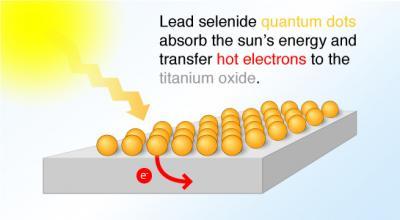
Quantum Dot Solar Cells
Pros:
§ Able to convert sunlight as well as use heat to produce electricity.
§ Clean power generation
§ Can possibly approach efficiencies of 65%.
Cons:
§ Hot electrons lose their energy as they travel.
§ Not Suitable for large scale manufacturing.
Overview: Research is still being done on quantum dot solar cells (QD), but they have been found to be very efficient. Once researchers are able to figure out how to consistently harness the majority of the suns light, quantum dot solar cells may be able to be implemented to solar modules. Right now QD solar cells are not able to be manufactured on a large scale, so implementing QD solar cells would have an insignificant impact.
Links:
Full Spectrum Solar Cells
Pros:
§ Able to convert the full solar spectrum, making it more efficient
§ Can possibly approach efficiencies of 70%.
§ Tremendous heat capacity
§ Cost-Efficient
Cons:
§ Crystals can be damaged easily.
§ Indium Nitride Crystals have many defects
Overview: Eventually we may be able to produce cheaper solar panels, that double efficiency, and are the same size as traditional panels. As of right now researchers are unable to control the formation of atomic clusters, that need to be absolutely perfect in order to capture the full color spectrum. Until they are able to consistently produce fully working full spectrum solar cells (researchers have been working for about 10 years, with little progress), silicon-cell PV systems are the way to go.
Links:
NanoSolar
Pros:
§ Efficient at converting sunlight to energy
§ More Versatile
§ Cost-Efficient
§ Extremely Flexible & Durable
§ Enables Longer Panel Array
§ Easier Installation
Cons:
§ Less Efficient than traditional silicon-based modules
Overview: If any of these technologies were to take over the future of solar energy, Nanotechnology would be the closest one. Nanotechnology uses thinner and lighter panels than traditional modules. Due to the increase in accessibility, installations are lest costly.
Links:
Top Five Recent Advancements In Solar Energy
1. Reflective Dishes
Reflector made of mirrors, that collects sunlight and intensifies it one thousand times over.
2. Spherical Solar Cells
Due to the spherical shape, the cells are able to absorb sunlight from all possible angles, generating more power and a better efficiency.
3. Paint On Solar Cells
-Most versatile type of solar cell, being that they can be placed virtually anywhere.
4. Solar Concentrators
-Increases the amount of sunlight being concentrated on the solar cells. Since more light is directed on the cell less photovoltaic material is needed, decreasing the price of the panel by half.
5. Nanotechnology powered Dye Sensitive Solar Cells
Cost efficient, beautiful to look at, and convert more light to energy.
New Advancements v.s. Traditional Photovoltaic System
With all the future advancements being researched, and all the future progressions, there is only one photovoltaic system that has withstood the test of time. Silicon-based PV systems have helped people achieve their electrical and financial goals using Silicon-based PV systems for over 45 year. [2] Industry reports claim that solar power grew at a rate of 40% per year within the last eight years. The reports also state that the cost per KW of photovoltaic systems have been decreasing, while the cost of electricity generated by fossil fuels has been steadily increasing. [3] The demand for solar photovoltaic systems is expected to double to 2 GW by next year and triple in size to 3 GW by 2012. The industries first billion dollar installation is set to take place this year, with the installation f a 290 megawatt Agua Caliente facility in Arizona . According to Industry reports, solar power will reach cost parity with conventional power sources in the U.S by 2015. Reports also indicate that solar Energy will grow to accommodate 10% of the U.S power necessities. In terms of watts, solar energy consumption will equal above 55,000 megawatts. This may not seem like much to many, but as of now solar energy currently provides less than 0.1% of the countries electricity.
References
October 26, 2010
Solar Energy For Dummies
What is Solar Energy?
“Going Green,” is becoming the most popular lifestyle across the world. Everyone is excited about saving the earth and recycling energy, all while cutting costs at the same time. Most people don’t know that there is an easy way to accomplish all of this and some without breaking your bank. Solar energy is radiation from the sun which can be converted into other forms of energy. Solar energy consists of electric energy and thermal energy. The first part of this week's blog series will explain how to convert solar energy into electric energy. Electric energy uses the suns radiation to produce electricity through solar cells, or photovoltaics (PV). There are three ways electric energy can be used; Stand- alone, Grid- connected, and Back-up. In Connecticut the Grid-connected system is used the most. A Grid-connected system uses utility supplied electricity only as a back up, if the solar energy system exhausts its electricity. Most of you may be thinking that it sounds great, but want to know exactly how it works.
Is Solar Energy Rocket Science?
Solar Energy comes off as a complex topic, when in all actuality it is quite simple.
· Solar Cells or Photovoltaic cells are silicon-based pieces of material that absorbs light from the sun.
· Many Solar Cells are combined into a solar panel.
· Solar Panels are than interlinked called an array which creates greater power.
· When Solar Energy hits the panel, it excites electrons in the solar cell and electricity is created.
· The electricity that is produced is in direct current (DC).
· Since most homes do not use DC, the electricity passes through an inverter which converts it to a common current called Alternating Current (AC). And just like that your house is now running on solar energy!
Show Me the Money!
Now that we’re enlightened about how to save electricity by using solar energy, we want to know how adding a Solar energy system actually saves us money. In Connecticut there is a simple process called Net Metering. Net Metering is a special arrangement between a homeowner and their utility company. It is an easy method which measures the difference between the electricity you buy from your local utility company and the excess you produce using your own photovoltaic system. So basically you use the electricity you generate first, which cuts down the amount you would usually buy. If you generate more energy than you use, the extra energy goes through the electric meter and back into the grid and supplied to other customers. According to the agreement that you sign with your local utility company, they will pay you for the energy you are giving back. So when you think about it, by using solar energy you can completely erase your energy bill, and make money by selling energy.
Net Metering alone is a good enough incentive to switch to solar energy, but there is more! Every state gives different tax incentives and rebates to people who use solar energy. In the state of Connecticut there is a State Rebate Program funded by the Connecticut Clean Energy Fund (CCEF) that pays residents $1.75/watt for the first 5 kilowatts of energy generated and $1.25/w for the next 5 kilowatts of energy that is generated.
Basically the CCEF will pay residents up to $15,000 annually for going green!
Homeowners are also able to take advantage of the federal incentives which include a Personal Tax Credit, where they can receive 30% back. Commercial property owners can choose between a 30% tax credit or a 30% federal grant. So along with net metering, you can receive a rebate, a tax incentive, and/or a federal grant. Why not just install a photovoltaic system right now?
Power Drill or Hammer?
The average Joe has had many successes when installing his own photovoltaic system. Unfortunately there has been many failures, which is why it’s recommended to hire a professional solar contractor. The Solar contractor will analyze your roofing and attic to make sure that the structure is able to withstand the light-weight system. Once ready to install they will choose the perfect system for you location and make sure that your panels are secured in the perfect position to achieve maximum solar output. Premier Solar Contractors like PurePoint Energy will even go tremendous lengths to help you obtain necessary rebates and the maximum tax credits and grants to benefit you. Now that we’re all Solar Energy Gurus, lets GO GREEN!
If not for any other reason…. Our President is Going Green!!!!
Subscribe to:
Posts (Atom)